
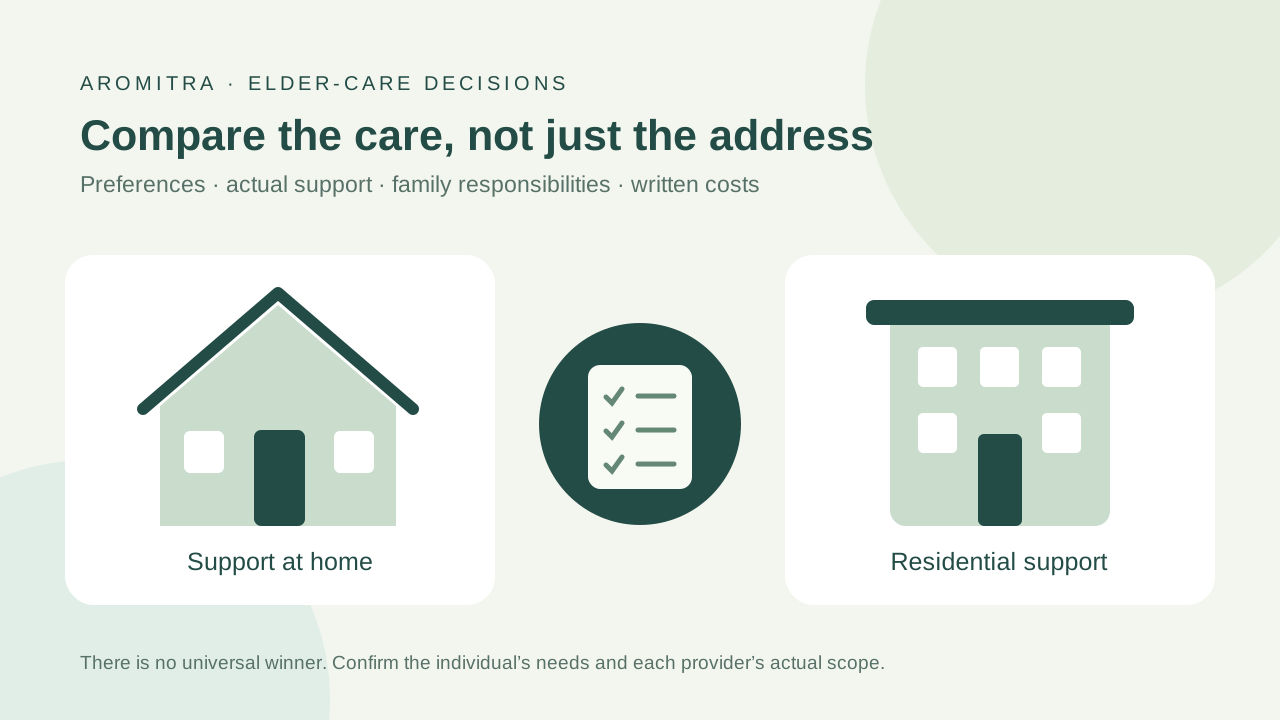
Choosing between care at home and a residential setting is not a test of how much a family loves an older relative. It is a practical decision about the person’s preferences, support needs, environment and what the family can reliably sustain.
This guide does not rank Chennai facilities or claim that home care is always better. Aromitra’s perspective is practical home-care planning; it is not an independent assessment of a particular residence. Ask the treating team for advice where medical, mobility or cognitive needs affect the choice.
General information only. Follow your healthcare team’s advice. Aromitra provides non-medical home care, not emergency services.
Do not compare marketing labels as if they were identical
Home care usually means support delivered where the person already lives. “Assisted living”, “senior living”, “retirement home” and “nursing care” may describe different arrangements. Do not infer the staffing, clinical coverage or included services from a name alone.
The NHS distinguishes residential personal care from nursing care in its UK guidance. That distinction is useful as a question to ask, but UK service definitions and regulation should not be assumed to describe a Chennai provider. Obtain the local provider’s precise scope in writing.
Build the same care brief for both options
Describe a normal day and a difficult day. This prevents a home-care quote for a few hours from being compared with a residential package whose scope is still unclear.
- What help is needed with daily routines, and what remains independent?
- Which hours need active assistance, including any overnight needs?
- Which tasks require a qualified healthcare professional?
- What matters most to the person: familiar surroundings, privacy, social contact, language or proximity to family?
- Who currently coordinates appointments, supplies, meals and changes to the plan?
- What support can the family realistically continue, rather than merely hope to provide?
Evaluate the home option honestly
A familiar home may support established routines, but familiarity does not answer every practical question. Check access, bathroom arrangements, space for any clinically recommended equipment and how the required duties will be covered. Ask the treating team about environmental or mobility concerns instead of improvising.
Then write down the work that remains with the family. A caregiver’s shift does not automatically include all shopping, transport, appointment coordination or household administration. If the family cannot cover a necessary gap, it must be resolved rather than left out of the comparison.
Evaluate a residence beyond the brochure
Visit a shortlisted setting where possible and use your care brief to ask specific questions. Do not treat a pleasant room or a broad “24/7 care” claim as evidence that every required task is covered.
- What staff are actually present during the day and overnight, and which roles do they hold?
- Which needs can the setting support, and what would require outside help or a move elsewhere?
- How are clinical appointments and urgent transfers coordinated?
- How are preferences, consent, privacy and family communication handled?
- Which activities are genuinely available, and is participation optional?
- How are complaints, absences and changes in needs addressed?
Compare the total arrangement, not the headline price
Request written quotes for the same care requirement and period. For home care, include confirmed staffing and any separate household, travel or professional-care expenses. For a residence, ask about deposits, room charges, care-level charges, excluded services and any additional costs that could apply. These are questions, not claims that every provider charges each item.
Record notice periods, refunds, price changes and what happens after hospitalisation or a change in needs. Do not assume that a monthly figure includes nursing or one-to-one support. This article gives no market-average rate because an unverified price would obscure the differences you need to understand.
Use a decision sheet, not a universal score
Make two columns, one for each real option you have investigated. Under each, record the person’s preference, confirmed support, unresolved gaps, family responsibilities, total quoted cost and backup plan. Mark unknowns as unknown rather than awarding points for reassuring language.
Some factors cannot be traded against price. If a necessary clinical service or safe staffing arrangement is missing, seek professional advice before treating that option as suitable. A cheaper arrangement is not a solution to an uncovered essential need.
Agree a review and transition plan
If an option is chosen, decide who coordinates the transition, what documents are needed and when the arrangement will be reviewed. Any trial or short stay must be agreed with the provider; do not assume it is offered or refundable. Keep the older person involved in decisions and listen to their experience after the change.
Could home care and outside services be combined? Sometimes a family may explore a mixed arrangement, but responsibilities and availability need explicit confirmation. Does assisted living automatically include nursing? No such assumption is safe. Does home care mean one person is available all day and night? No: shifts, rest and backup cover must be specified.
If you are exploring practical support at home in Chennai, Aromitra can receive an enquiry. Confirm suitability and current availability before making a decision; this article does not confirm staff availability or promise a start date.
Sources and further reading
Sources checked on 13 November 2026. These organisations provide the background guidance; they have not reviewed or endorsed this Aromitra article. Local care pathways may differ.
Discuss practical support in Chennai
Tell Aromitra about the practical tasks, locality and preferred dates. Confirm current availability, suitability, role boundaries and written terms before relying on an arrangement. Aromitra is not an emergency service.
Talk to a Care Coordinator