
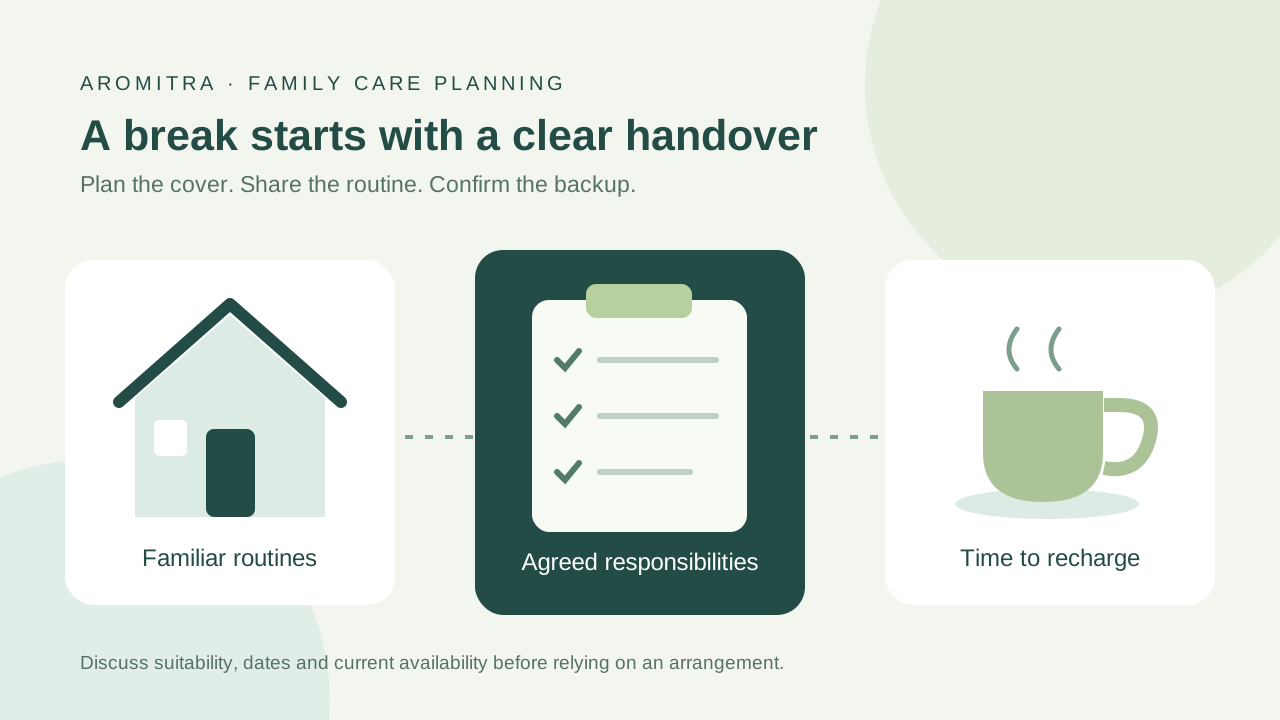
Taking time away from caring does not mean caring less. A break is more useful when the person receiving care has a clear support arrangement and the family caregiver knows who is responsible while they are away.
Respite care means temporary replacement support so the usual caregiver can take a break. It may happen at home or in another suitable setting. Availability and suitability vary. This guide is a planning worksheet for Chennai families, not a promise of immediate, hourly or short-stay availability from Aromitra.
General information only. Follow your healthcare team’s advice. Aromitra provides non-medical home care, not emergency services.
Begin with the break you actually need
Write the dates and the purpose of the cover: a medical appointment, a family event, travel or time to rest. Then identify the period during which someone must actively take responsibility. Include handover time rather than planning for the replacement to arrive at the exact moment you need to leave.
Discuss the arrangement with the person receiving care. Ask what would help them feel comfortable with someone else and what they want to keep unchanged. Where decisions require support, involve the appropriate family members and healthcare team without excluding the person’s preferences.
Choose the setting around the person, not the label
The NHS describes several forms of respite, including help at home and temporary stays in a care setting. Those are categories, not a directory of services available in Chennai. UK funding and eligibility rules do not apply here.
For your family, compare practical questions: can the existing home routine be covered safely; would a change of setting be acceptable; and does the proposed provider actually support the required tasks? Clinical needs should be assessed by the treating team. A non-clinical caregiver is not a substitute for qualified nursing or emergency care.
Write a temporary-cover brief
A useful brief fits on one page. Keep detailed records private and share only information needed for the agreed role.
- Dates, locality and exact start and finish times, including handover.
- The person’s preferred name, language, daily routine and privacy preferences.
- Practical tasks needed during this period and tasks the person does independently.
- Any relevant instructions from the healthcare team and the professional responsible for clinical tasks.
- The family contact, a backup contact and the agreed route for urgent medical concerns.
- Who will be present at the start and end, and what happens if the family is delayed.
Confirm the agreement before changing your plans
Ask for the provider’s confirmation of the particular dates, role and terms. An enquiry acknowledgement is not confirmation that cover is arranged. Do not book non-refundable travel on the assumption that a worker will be available.
Request a written total with any minimum booking period, extra-hour charges and cancellation terms. Ask how absence or a mismatch would be handled and whether an alternative can actually be provided. A replacement policy is not the same as a guarantee that another suitable person is immediately available.
Make the first handover calm and specific
If practical and agreed, allow time for the person receiving care and the replacement worker to meet before the family caregiver leaves. Explain the usual routine and the boundaries of the role. Avoid conflicting instructions from several relatives; nominate one person to coordinate changes.
Leave a factual handover sheet, not an informal request to “do whatever is needed”. Clinical procedures, medication decisions and new health concerns belong with the appropriate professionals. Explain how the worker should report an observation without asking them to diagnose it.
Agree check-ins without recreating the whole workload
Decide in advance what needs an immediate call and what can wait for a routine update. A short check-in at an agreed time may be more useful than expecting constant photos or messages. Protect the person’s dignity and consent; do not use updates as permission to share private care details widely.
Plan for ordinary disruptions as well: a late return, access problems or a worker who cannot complete the shift. Name the family backup rather than assuming the provider can extend cover indefinitely.
Review the arrangement together
Afterwards, ask the person receiving care and the replacement worker what went smoothly and what needs clarification. Record practical changes for another occasion. The aim is a repeatable handover that supports both people, not a judgement on the family caregiver for needing time away.
Can respite be just a few hours? Some providers may offer short periods, but check minimum duration and availability directly. Is a live-in worker continuous awake cover? No: duties, rest and relief must be agreed. Can respite include nursing? Only when the appropriate qualified clinical support has been separately confirmed.
Sources and further reading
Sources checked on 13 November 2026. These organisations provide the background guidance; they have not reviewed or endorsed this Aromitra article. Local care pathways may differ.
Discuss practical support in Chennai
Tell Aromitra about the practical tasks, locality and preferred dates. Confirm current availability, suitability, role boundaries and written terms before relying on an arrangement. Aromitra is not an emergency service.
Talk to a Care Coordinator